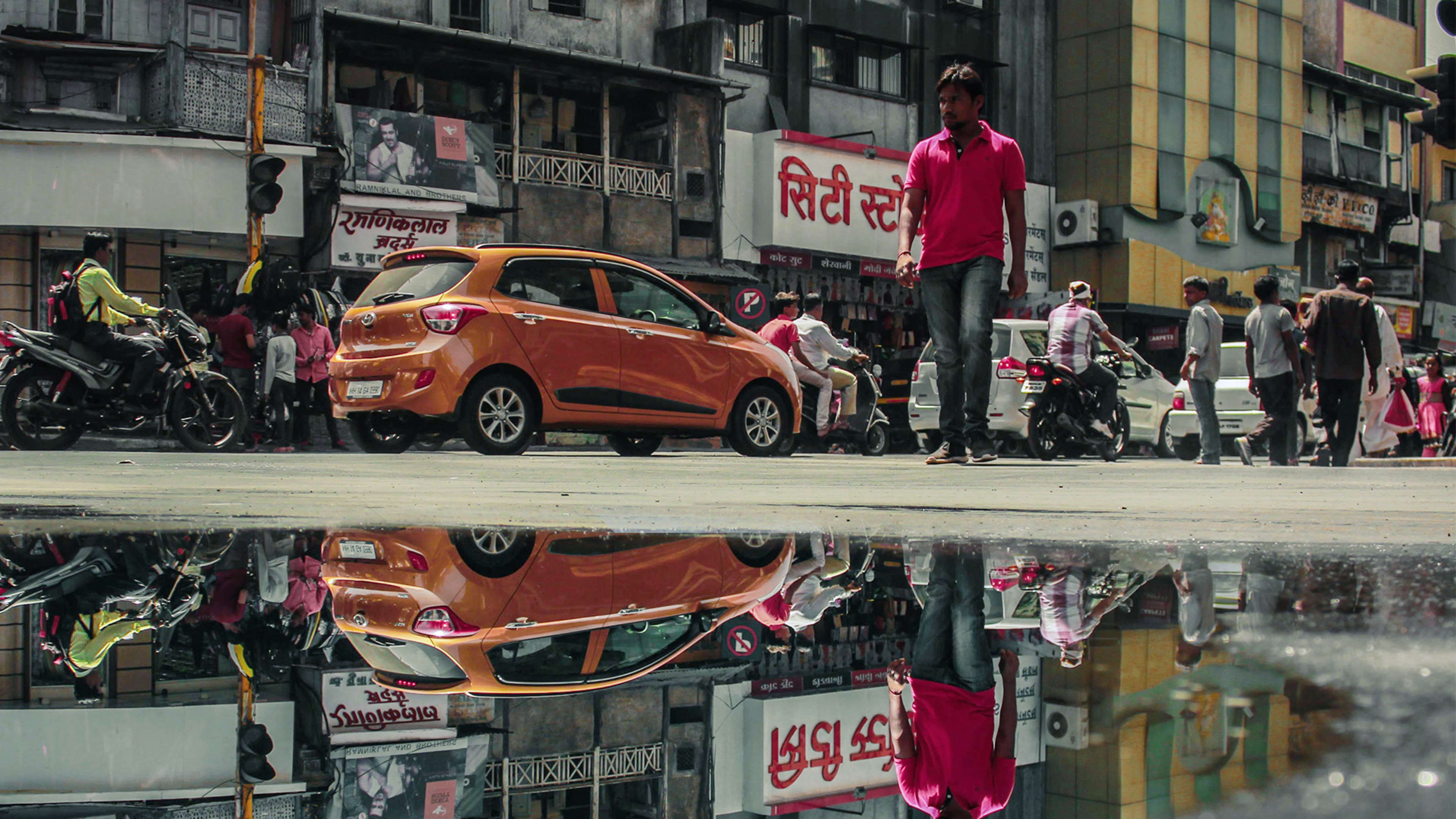
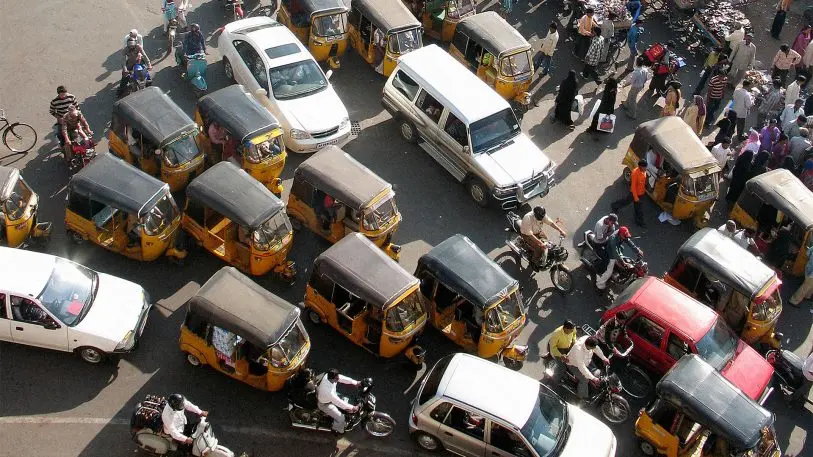
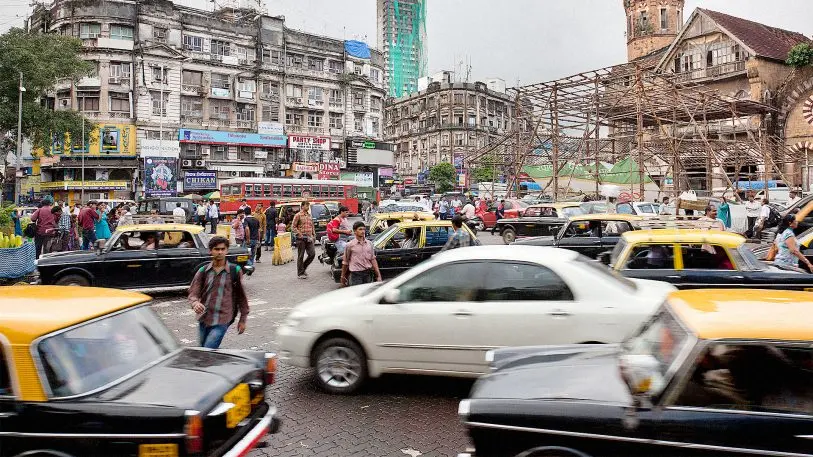
At rush hour, the gridlock on a highway in Delhi, India, looks a lot like Los Angeles. As more Indians are able to afford cars–and as the country’s population soon becomes the largest in the world–traffic and pollution throughout the country could be set to become much, much worse. But the government has decided to try to develop in a radically different direction than America, avoiding further sprawl and car-dependency. By the end of next decade, it wants most–if not all–vehicles in India to run on electricity, most cars to be shared, and cities to be designed for humans rather than cars.
If successful, the shift would save the country $60 billion in diesel and gas costs in 2030. Instead of 170 million cars, the number expected with the current trajectory, there would be 77 million. CO2 emissions from passenger transport would drop 37% compared to the business-as-usual scenario; energy use in passenger transport would drop 64%.
No Time Like The Present
“We think there’s this window of opportunity that is fleeting, but also very real, for India to be in a more advantageous position than any other nation that we know of to leapfrog the internal combustion engine, private vehicle ownership model that a lot of other countries are trying to undo,” says Clay Stranger, a principal at Rocky Mountain Institute, a nonprofit that is working with the Indian government to strategize about how to reach that goal through a long series of steps, such as a gas car tax to help fund the construction of charging stations for electric cars.
India has already “leapfrogged” Western technology in other ways. In the early 1990s, 0.05% of the population had access to a phone. When the country wanted to expand access, instead of building landlines, it encouraged the growth of mobile phones. By 2016, there were more than 1 billion mobile subscribers. Some remote Indian villages have gained access to electricity through solar panels rather than building traditional power plants.
The country’s current situation lends itself to the shift to sustainable mobility. In Indian cities now, most trips are made by foot, bike, or public transit. That’s largely because people can’t afford to drive–but encouraging people to continue current habits is easier than changing habits in a car-dependant city. Only 18 out of 1,000 people own a car, versus 786 out of 1,000 in the United States. That also makes the full transition to electric cars easier, as there are fewer gas cars on the road that need to be replaced. Shared transportation is also already widely accepted.
“The prevalence of shared mobility is completely accepted, used, and normalized in India,” says Stranger. “In some ways, you could almost argue it was invented there out of necessity. Auto-rickshaws that drive semi-fixed routes picking up passengers and dropping them off at not-predetermined stops as people need to board or get off . . . have been a part of Indian life for at least the last century. Before that, it was bicycle rickshaws.”
The Future Is Electric
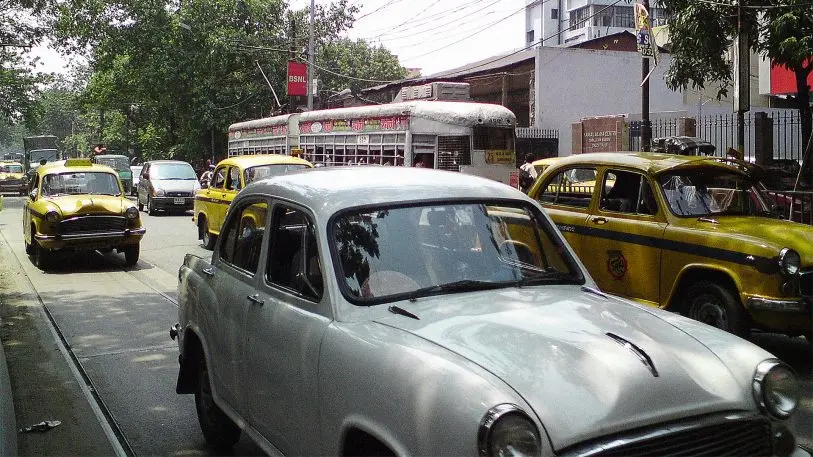
As incomes rise in India and more people buy cars (car ownership has tripled over the last decade) it coincides with global changes in both technology and new business models for transportation such as ride hailing. The cost of battery packs for electric cars has dropped 80% in the last six years. In January of 2017, 37% of the cars sold in Norway were electric. In Japan, there are now more electric charging stations than gas stations.
“We see EVs right now at a tipping point,” says Stranger. “With any big system transformation, it’s hard to imagine the other side from where you sit today, but we see globally EV sales having grown 42% in 2016 . . . We see EVs reaching sticker price parity with internal combustion engine vehicles in the early 2020s.”
Indian carmaker Mahindra & Mahindra already makes electric cars; Tata Motors is developing both hybrid and fully electric cars, along with hybrid and electric buses. Ride hailing, which the government also wants to push, is already quickly growing in Indian cities.
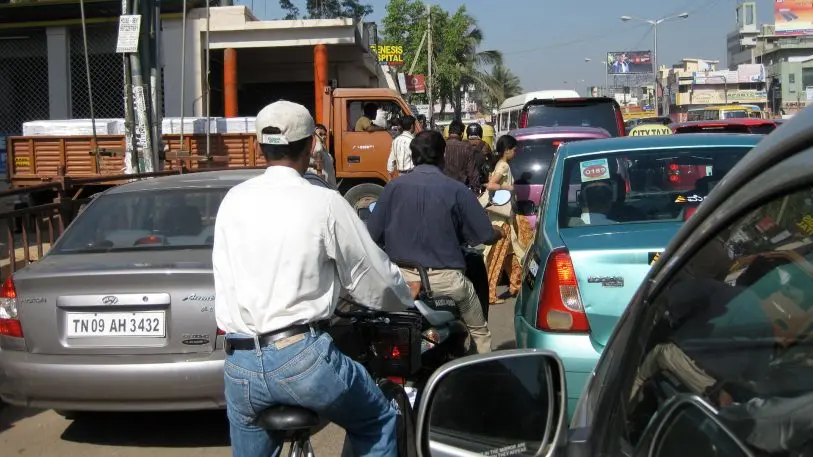
Even with relatively low car ownership now, Indians are already seeing the need for change. Traffic jams happen even on 26-lane highways. Hundreds of people are killed in traffic every day. Thirteen of the 20 most polluted cities in the world are in India. In November 2016, the air pollution index in Delhi hit 999 (anything over 500 is hazardous). Four out of 10 children in Delhi have respiratory problems.
The plan to shift to electric cars also supports India’s shift to renewable energy. By 2022, the country is aiming for 175 gigawatts of renewable electricity capacity, four times more than when it set that goal in 2015. Electric cars, plugged into smart chargers that charge when power production peaks but demand is low, could help grids running mostly on solar and wind power run smoothly.
For electric scooters and motorcycles and three-wheeled electric vehicles, the government is considering a system of swappable batteries. Extra batteries would sit in battery banks, charging at the best time to help the grid. If someone riding a motorcycle noticed that their battery was low, they would swap in a new one rather than waiting to plug the vehicle in to charge. If batteries were sold separately from the vehicle, that would also help bring down the initial cost of electric options. (This swappable system is similar to the model attempted by Better Place in Israel, which ultimately failed; Stranger says that the physics and economics work well for smaller vehicles, but not for cars.)
A New Mobility By 2030
In a meeting in February, the Rocky Mountain Institute and the National Institution for Transforming India (NITI Aayog), a government policy think tank, brought together a group of government leaders, auto manufacturers, ride-hailing companies, and nonprofits to begin to make a plan to transform mobility in India by 2030.
The first phase, designed to build market confidence, would set up electric vehicle incentives for manufacturers and consumers, like “feebates” that charge fees on less efficient vehicles in order to offer rebates on those that are more efficient. New institutions would be set up to support the transition. By 2020, subsidies would shift to a market-led approach. Certain cities would pilot new technology and business models to be shared with the rest of the country. By 2023, both electric infrastructure and services like ride hailing would quickly scale through the entire country.
Two-wheeled electric vehicles, which are already cost-competitive with their non-electric counterparts, would be emphasized first, followed by three-wheeled electric vehicles, and finally cars. It’s a different approach than the subsidy-heavy push for electric cars taken in China, where government support is leading to rapid adoption of EVs. India wants to drive the transition through the market, as much as possible, rather than through public funds.
It’s a challenging plan (and not yet final–the government plans to implement a set of policy frameworks by the end of 2017). But Stranger says that “mega changes” in mobility are already underway, and India has shown an ability to move quickly in the past. “I think India’s proven a serious track record with fast-paced transformation,” he says.
In 2014, through buying hundreds of millions of LED light bulbs in bulk, India was able to drive down the unit cost by 76%, shifting the whole country from incandescent bulbs. It’s now considering a public-private partnership for the mass procurement of vehicles. Another solution may be a system to manufacture some common parts across all electric vehicles to help cut costs.
Disrupting Car Ownership
One of many challenges is the fact that in India–as in the rest of the world–owning a car is seen as a status symbol. “People aspire to go from nothing to a bicycle, to a two-wheeler, to eventually a car,” says Stranger. But as more and more Indians achieve their aspirations, the status symbol isn’t worth as much.
One tech worker in Bangalore, who says that his eight-mile commute regularly takes 90 minutes, writes in a blog post that driving himself now seems like a waste of time:
It was about time in Bangalore where owning a car was no longer a status symbol (unlike in many other parts of India) and more of a “negative” status symbol–a person who was still driving his own vehicle to work was slowly being seen as someone who had lots of time on his hands and also as someone who couldn’t afford a cab !
“The model of ride sharing encourages fewer cars per mile,” says Andrew Salzberg, head of transportation policy and research for Uber. “That means two things. If you want to get to electrification, it’s probably easier to convert a million cars to electric cars than a billion cars. And just by having fewer cars doing more miles overall, if you look at the economics of higher-efficiency vehicles, they tend to pay off more the more you use them because the operating costs become more important.”
As India makes its shift, it could serve as a model for other developing countries. It could also leverage its engineering talent to sell cars to other countries. “If India’s able to produce low-cost, high-quality electric vehicles that are sort of purpose-designed for emerging markets, we see a huge opportunity for them to be the technology suppliers for both their neighboring countries and for a lot of emerging economies globally,” says Stranger.
Americans might also soon be driving Indian electric cars. “I personally would like to see India develop the budget-electric autonomous car,” he says. “When you look at the Tatas and the Mahindras of India, they’re absolutely world-class software engineers and OEMs. So the opportunity to develop autonomous or semi-autonomous electric vehicles is enormous, and I think there would be a market for those globally, not just in emerging economies.”
Recognize your brand’s excellence by applying to this year’s Brands That Matter Awards before the early-rate deadline, May 3.